.svg)


Equipment failures don't wait for convenient timing. When critical machinery breaks down unexpectedly, the costs ripple through operations with unplanned downtime, emergency repairs, and lost productivity. A well-designed preventive maintenance checklist can help transform this reactive cycle into a proactive strategy that protects both your assets and your bottom line.
Industrial operations rely on consistent equipment performance. Whether you're managing manufacturing lines, power generation equipment, or processing facilities, systematic maintenance planning directly impacts operational efficiency and regulatory compliance. This comprehensive guide will walk you through understanding preventive maintenance checklists, their critical importance, and a step-by-step approach to creating an effective system for your organization.
A preventive maintenance checklist is a structured document that outlines specific maintenance activities required to keep equipment operating at peak performance. Think of it as a roadmap that guides maintenance teams through systematic inspections, routine servicing, and proactive repairs before problems escalate into costly failures.
Beyond task organization, the checklist standardizes maintenance procedures, removing the guesswork and reliance on memory from maintenance activities, ensuring compliance with manufacturer and regulatory requirements, and facilitating a historical record of equipment condition and work performed. Technicians follow clear steps that capture institutional knowledge and best practices—reducing human error, improving consistency, and maintaining equipment reliability across the organization, regardless of staff experience or turnover. When properly implemented, it forms the backbone of a reliable maintenance management system.
Preventive maintenance is a proactive strategy focused on guarding against equipment failures before they occur. Unlike reactive maintenance, which addresses problems after they happen, preventive maintenance follows scheduled intervals based on time, usage, or condition indicators.
This approach encompasses routine inspections, lubrication, part replacements, calibrations, and adjustments performed at predetermined frequencies. The strategy recognizes that equipment degrades predictably over time and usage, making it possible to intervene before critical failures occur.
Research consistently demonstrates the financial benefits of preventive maintenance. Organizations implementing comprehensive preventive maintenance programs typically see more cost savings compared to reactive maintenance approaches. These savings stem from reduced emergency repairs, extended equipment life, improved energy efficiency, and minimized production disruptions.
The importance of preventive maintenance checklists extends far beyond operational convenience. These tools directly impact organizational performance across multiple dimensions that matter most to industrial operations.
Equipment failures cost industrial facilities tens of thousands to hundreds of thousands of dollars per hour in lost production, according to Aberdeen Research.
Preventive maintenance checklists help organizations maintain compliance with safety regulations and industry standards. Regular inspections identify potential hazards before they threaten worker safety or environmental compliance. For organizations subject to regulations from OSHA, EPA, or industry-specific bodies, documented preventive maintenance provides essential compliance evidence.
Unplanned downtime disrupts production schedules, delays customer deliveries, and forces costly overtime repairs. Preventive maintenance checklists help maintain consistent equipment performance allowing operations teams to plan maintenance windows that minimize production impact. This predictability enables better resource allocation and more reliable delivery commitments.
Equipment represents a significant capital investment. Preventive maintenance extends asset life, maintains warranty compliance, and preserves resale value. Organizations with strong preventive maintenance programs typically achieve 20-30% longer equipment life compared to reactive maintenance approaches according to the U.S. Department of Energy.
Creating an effective preventive maintenance checklist requires systematic planning and attention to operational realities. Follow these structured steps to develop checklists that drive real operational improvements.
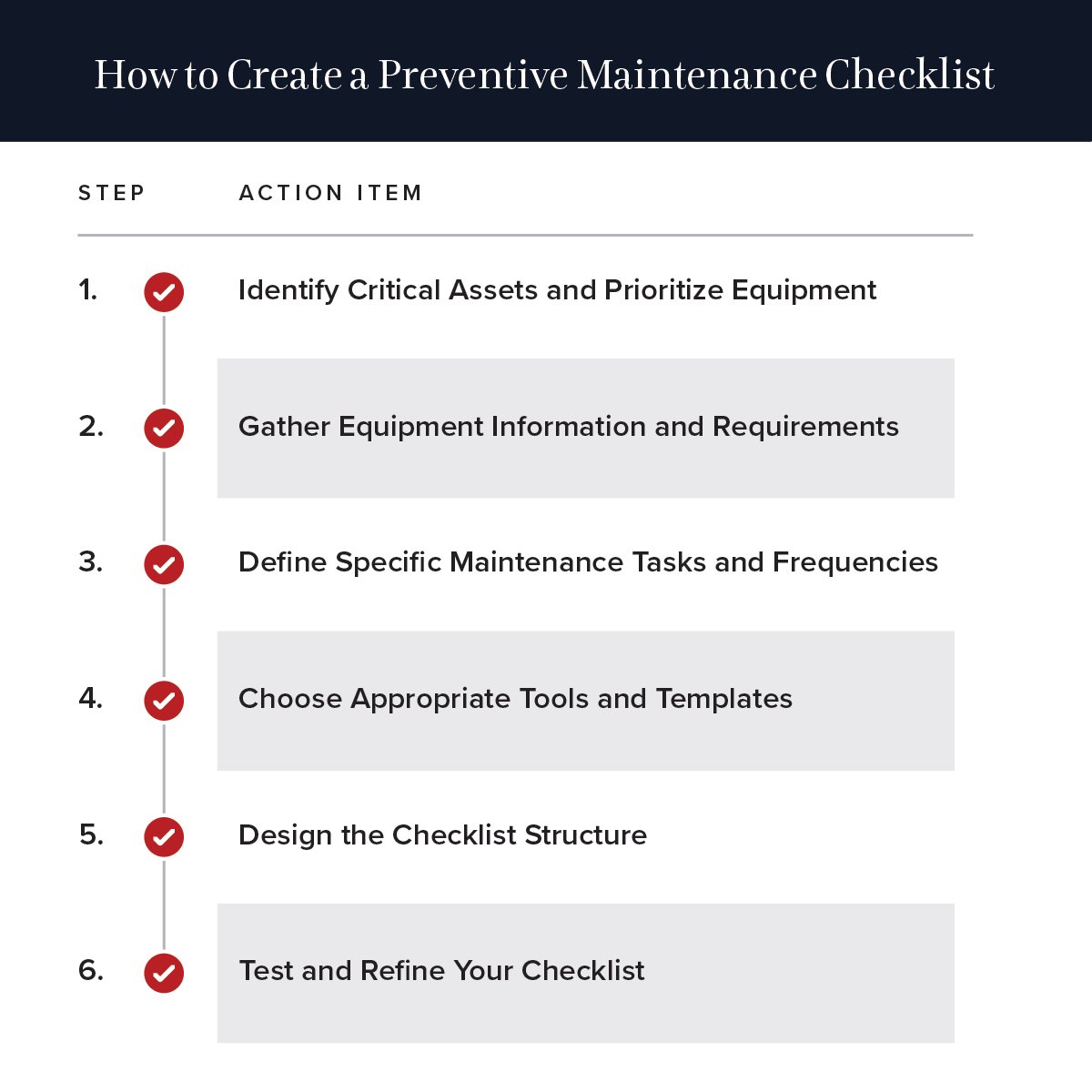
Start by cataloging all equipment in your facility and assessing criticality based on operational impact, safety considerations, and replacement costs. Focus initial efforts on assets where failure would cause the greatest disruption or risk.
Create a criticality matrix that evaluates each asset across three dimensions: safety impact (potential for injury or environmental damage), operational impact (effect on production or service delivery), and financial impact (repair costs and downtime expenses). This analysis helps prioritize which equipment needs the most comprehensive preventive maintenance attention.
Document each critical asset's specifications, including manufacturer information, model numbers, installation dates, and operating parameters. This foundational information supports accurate maintenance planning and helps ensure procedures align with manufacturer recommendations.
Collect comprehensive technical documentation for each prioritized asset. This includes manufacturer maintenance manuals, warranty requirements, regulatory compliance standards, and historical maintenance records. Understanding these requirements ensures your checklists address all necessary maintenance activities.
Review manufacturer recommendations carefully, as these often specify required maintenance intervals, approved lubricants, replacement part specifications, and safety procedures. Ignoring manufacturer guidelines can void warranties and create safety risks.
Identify applicable regulatory requirements that affect your equipment. Power generation facilities must comply with NERC standards, chemical plants follow EPA guidelines, and manufacturing operations adhere to OSHA requirements. Build these compliance requirements directly into your preventive maintenance procedures.
Break down maintenance requirements into specific, actionable tasks that technicians can complete consistently. Avoid vague instructions like "check equipment condition." Instead, specify measurable criteria such as "verify bearing temperature does not exceed 180°F per manufacturer specifications" or "confirm vibration levels remain below 0.3 inches per second."
Establish maintenance frequencies based on manufacturer recommendations, operating conditions, and historical performance data. Consider factors like operating hours, environmental conditions, production demands, and equipment age when setting intervals.
Group related tasks into logical maintenance packages. For example, combine lubrication, belt tension checks, and alignment verification into monthly mechanical maintenance rounds. This grouping improves efficiency and ensures comprehensive equipment coverage.
Select maintenance asset management tools that support your operational requirements. Digital platforms offer significant advantages over paper-based systems, including automated scheduling, real-time data collection, photo documentation capabilities, and integrated reporting features.
Consider enterprise asset management (EAM) software that integrates with your existing ERP systems. EAM platforms can automatically generate work orders, track parts inventory, manage maintenance schedules, and provide analytics on maintenance performance.
Look for solutions that allow easy customization, offline data collection, and seamless data sharing across maintenance teams.
Organize your preventive maintenance checklist with clear sections that guide technicians through systematic inspections and maintenance activities. Include equipment identification information, safety requirements, required tools, and detailed task instructions.
Structure each checklist with the following elements:
Design checklists for mobile access, as maintenance technicians often work in field locations where accessing desktop computers is impractical. Ensure forms work reliably on tablets and smartphones, with clear layouts that remain readable in industrial environments.
Pilot your preventive maintenance checklists with experienced technicians who can identify practical issues and improvement opportunities. Pay attention to task clarity, time requirements, and any missing steps that become apparent during actual use.
Gather feedback on checklist usability, including whether instructions are clear, tasks are logically sequenced, and time estimates are realistic. Technicians often identify safety considerations or efficiency improvements that weren't apparent during initial planning.
Refine checklists based on pilot feedback, then gradually expand implementation across your maintenance program. Monitor completion times, identify recurring issues, and adjust procedures as needed to optimize effectiveness.
Preventive maintenance checklists vary significantly based on equipment type, industry requirements, and maintenance strategies. Understanding these variations helps organizations develop appropriate approaches for their specific operational needs.
These checklists follow calendar-based schedules, such as weekly, monthly, or annual maintenance activities. They work well for equipment with predictable wear patterns and relatively consistent operating conditions. Examples include HVAC system maintenance, emergency generator testing, and safety equipment inspections.
These checklists trigger maintenance based on operational metrics like operating hours, production cycles, or cumulative usage. They're ideal for equipment where wear correlates more closely with usage than calendar time. Examples include vehicle maintenance based on mileage, production equipment maintenance based on cycles, and pump maintenance based on operating hours.
Condition-based preventive maintenance checklists incorporate condition monitoring data to trigger maintenance activities when specific thresholds are reached. They represent the most advanced preventive maintenance approach, using vibration analysis, thermal imaging, oil analysis, or other diagnostic techniques to determine optimal maintenance timing.
These specialized checklists ensure organizations meet industry-specific regulatory requirements. They often have non-negotiable timing requirements and documentation standards. Examples include pressure vessel inspections, environmental monitoring equipment calibrations, and safety system testing.
Industrial facilities face unique challenges that require specialized approaches to preventive maintenance planning. Understanding these considerations helps organizations develop robust maintenance programs that address operational realities.
Manufacturing facilities must balance maintenance activities with production schedules. Preventive maintenance checklists should accommodate production windows, minimize changeover disruptions, and coordinate with production planning systems. Consider maintenance activities that can occur during production versus those requiring equipment shutdown.
Coordinate preventive maintenance with planned production stops, such as product changeovers or scheduled breaks. This coordination maximizes maintenance efficiency while minimizing production impact.
Power generation facilities operate under strict regulatory oversight and reliability requirements. Preventive maintenance checklists must address NERC compliance, environmental regulations, and grid reliability standards. These operations often require extensive documentation and regulatory reporting.
Consider seasonal maintenance requirements, such as winterization procedures or cooling system preparation for summer peak demand. Plan maintenance activities around demand forecasts and grid reliability commitments.
Chemical facilities face additional safety considerations related to hazardous materials, process safety management, and environmental protection. Preventive maintenance checklists must address process safety information and hazard analysis requirements.
Integrate process safety considerations into maintenance planning, including hot work permits, confined space entry procedures, and emergency response coordination.
Heavy industry and mining operations often involve large-scale equipment operating in harsh environments. Preventive maintenance checklists must address equipment accessibility, environmental exposure, and the logistics of maintaining massive assets.
Consider maintenance activities that can be performed while equipment remains in operation versus those requiring complete shutdowns. Plan for equipment access requirements, including crane availability, scaffolding needs, and safety considerations for working at height.
Implementing preventive maintenance checklists effectively requires attention to organizational factors beyond technical considerations. These best practices help organizations realize the full potential of their preventive maintenance investments.
Establish maintenance schedules that balance operational requirements with resource availability. Use historical data and manufacturer recommendations as starting points, but adjust frequencies based on actual equipment performance and operating conditions.
Implement the 10% rule for preventive maintenance scheduling, which allows completion within 10% of the scheduled timeframe. This flexibility accommodates operational priorities while maintaining maintenance discipline.
Monitor maintenance effectiveness through key performance indicators such as mean time between failures (MTBF), maintenance costs per unit of production, and schedule compliance rates. Use this data to optimize maintenance frequencies and identify improvement opportunities.
Provide comprehensive training on checklist procedures, ensuring technicians understand not just what to do, but why each task matters. Training should cover safety procedures, quality standards, documentation requirements, and troubleshooting techniques.
Establish clear accountability for preventive maintenance completion, including supervisor review requirements and quality auditing procedures. Regular audits help identify training needs and ensure consistent execution across maintenance teams.
Create feedback mechanisms that allow technicians to suggest improvements to preventive maintenance procedures. Frontline staff often identify practical improvements that enhance safety, efficiency, or effectiveness.
Regularly review preventive maintenance performance data to identify trends and improvement opportunities. Look for recurring problems, excessive maintenance costs, or equipment that requires more frequent attention than anticipated.
Conduct failure analysis on equipment breakdowns to determine whether preventive maintenance procedures were adequate or need enhancement. Use this analysis to refine checklist procedures and maintenance frequencies.
Benchmark maintenance performance against industry standards and internal historical data. This analysis helps identify areas where preventive maintenance programs excel and areas needing improvement.
Leverage technology to enhance preventive maintenance effectiveness. Mobile devices enable real-time data collection, photo documentation, and immediate access to equipment history and procedures.
Integrate preventive maintenance systems with other organizational systems, such as enterprise resource planning (ERP), inventory management, and production planning & scheduling systems. This integration improves resource coordination and enables better decision-making.
Use data analytics to identify patterns in equipment performance and maintenance effectiveness. Advanced analytics can help optimize maintenance frequencies, predict failure modes, and improve resource allocation.
Preventive maintenance checklists represent more than administrative tools—they form the foundation of operational excellence in industrial environments. Organizations that implement comprehensive, well-designed preventive maintenance programs consistently outperform reactive maintenance approaches across cost, reliability, and safety metrics.
The journey from reactive to proactive maintenance requires systematic planning, organizational commitment, and continuous improvement. Start with your most critical assets, develop thorough procedures, and build competency through consistent execution. As your preventive maintenance program matures, expand coverage and incorporate advanced technologies that enhance effectiveness.
Success in preventive maintenance comes from treating it as a strategic capability rather than a necessary cost. Organizations that view maintenance as an investment in operational reliability, safety, and long-term competitiveness position themselves for sustained success in increasingly demanding industrial markets.
Your equipment investments deserve protection through systematic care. Begin developing your preventive maintenance checklist program today, focusing on your most critical assets and building from proven practices. The operational improvements and cost savings will validate your investment while positioning your organization for long-term success.
Connect with Prometheus Group to discover how our industry-leading Asset Performance Management (RapidAPM) solution can simplify preventive maintenance and turn your checklist into a powerful tool for reliability. Our experts are ready to guide you through smarter, more efficient maintenance processes that protect your assets and deliver lasting results.
Contact us today to learn how we can support your journey toward proactive maintenance and improved operational performance.
Preventive maintenance management is a proactive strategy focused on guarding against equipment failures before they occur. Unlike reactive maintenance, which addresses problems after they happen, preventive maintenance follows scheduled intervals based on time, usage, or condition indicators.
The importance of preventive maintenance checklists extends far beyond operational convenience. These tools directly impact organizational performance across multiple dimensions that matter most to industrial operations. Preventive maintenance benefits include financial savings, safety and compliance, operational reliability, and asset optimization.
See the Prometheus Platform in Action
Discover how you can streamline your asset management processes and maximize your ROI.