.svg)


Contents
Equipment failure is one of the costliest challenges industrial operations face. When critical assets go down unexpectedly, the ripple effects can disrupt production schedules, compromise safety standards, and drain maintenance budgets. The solution lies in choosing the right maintenance approach. But which strategy delivers the best results for your operations?
Understanding the fundamental differences between preventive maintenance and breakdown maintenance is essential for making informed decisions that protect your assets and optimize your maintenance budget. Each approach serves specific purposes and offers distinct advantages depending on your equipment criticality, operational goals, and resource constraints.
This comprehensive guide examines both maintenance strategies in detail, helping you determine the optimal approach for your facility. We'll explore real-world applications, cost implications, and best practices that leading industrial organizations use to maximize equipment reliability while controlling maintenance expenses.
Preventive maintenance is a proactive maintenance strategy that involves performing scheduled inspections, servicing, and component replacements before equipment failures occur. This approach follows predetermined schedules based on time intervals, usage hours, or manufacturer recommendations to keep assets operating at peak performance.
The core principle behind preventive maintenance centers on addressing potential issues before they escalate into costly breakdowns. Maintenance teams conduct regular inspections, replace wear parts according to established schedules, and perform routine servicing tasks like lubrication and calibration.
Modern preventive maintenance encompasses several specialized approaches:
Time-Based Maintenance (TBM) follows fixed schedules regardless of equipment condition. For example, changing air filters every 90 days or replacing belts annually based on manufacturer specifications.
Condition-Based Maintenance (CBM) monitors equipment performance indicators to determine when maintenance is needed. Teams use vibration analysis, oil sampling, or thermal imaging to assess asset health and schedule maintenance accordingly.
Predictive Maintenance (PdM) leverages advanced sensors and data analytics to forecast potential failures before they occur. This sophisticated approach uses machine learning algorithms to identify patterns that indicate declining equipment performance.
Risk-Based Maintenance (RBM) prioritizes maintenance activities based on the potential consequences of equipment failure. Critical assets receive more frequent attention than non-essential equipment.
Breakdown maintenance, also known as reactive or run-to-failure maintenance, involves repairing or replacing equipment only after it has failed or stopped functioning. This approach waits for actual breakdowns to occur before taking corrective action.
While this might seem like poor planning, breakdown maintenance can be strategically appropriate for certain types of equipment. The key is understanding when this approach makes economic sense and when it poses unacceptable risks to operations.
Breakdown maintenance falls into two distinct categories:
Planned Breakdown Maintenance involves deliberately allowing certain equipment to run until failure when the consequences are manageable and replacement costs are lower than preventive maintenance expenses. For example, allowing inexpensive light bulbs to burn out before replacement.
Unplanned Breakdown Maintenance occurs when equipment fails unexpectedly, requiring emergency repairs to restore operations. This typically results in higher costs due to rushed repairs, overtime labor, and potential production losses.
The fundamental distinction between these maintenance strategies lies in their timing and approach to equipment care. Preventive maintenance takes action before problems occur, while breakdown maintenance responds after failures happen. 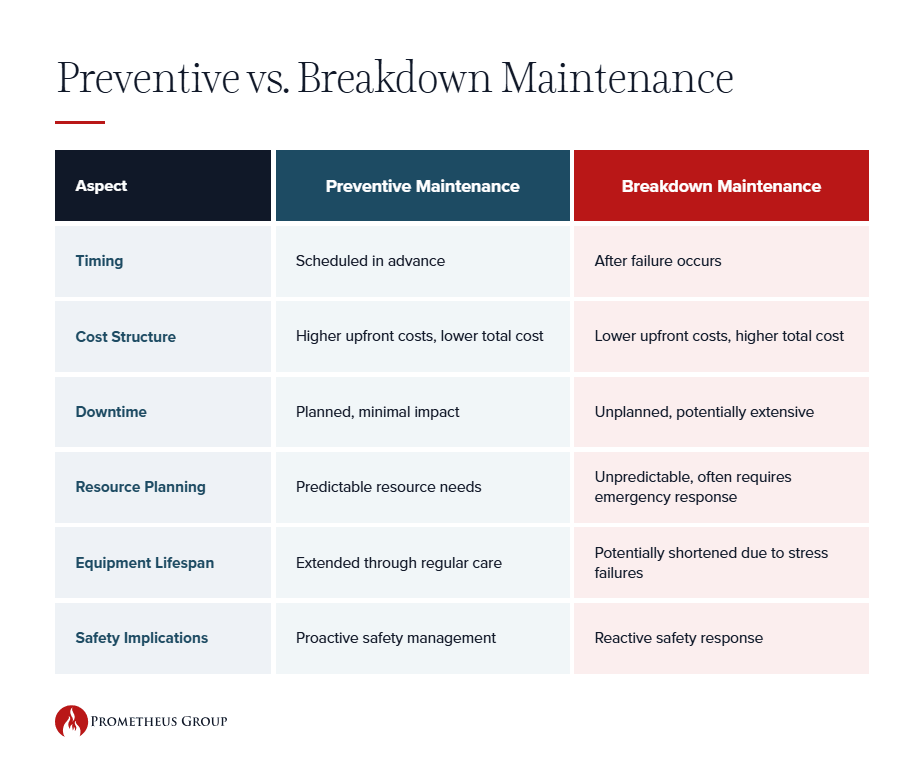
Implementing a robust preventive maintenance program delivers measurable advantages that extend far beyond avoiding equipment failures. These benefits compound over time, creating significant operational improvements and cost savings.
Regular maintenance significantly extends asset life by addressing wear and degradation before they cause permanent damage. Well-maintained equipment can operate longer than assets receiving only breakdown maintenance, maximizing your capital investment returns.
Scheduled maintenance allows for better budget planning and resource allocation. You can forecast maintenance expenses more accurately, negotiate better pricing for parts and services, and avoid the premium costs associated with emergency repairs.
Proactive maintenance helps identify potential safety hazards before they cause incidents. Regular inspections ensure equipment meets regulatory requirements and maintains proper safety systems, reducing liability and compliance risks.
Well-maintained equipment operates more efficiently, consuming less energy and producing higher-quality output. This improved performance translates to lower operating costs and better product consistency.
While breakdown maintenance may seem cost-effective initially, it often leads to higher total ownership costs and operational challenges that impact long-term profitability.
Equipment failures rarely occur at convenient times. Emergency repairs often require premium-priced parts, overtime labor, and expedited shipping, significantly increasing maintenance costs compared to planned activities.
Unplanned failures typically result in longer downtime than scheduled maintenance windows. Teams must diagnose problems, source parts, and coordinate repairs without advance preparation, extending the time equipment remains offline.
Unexpected failures can create safety hazards for personnel and environmental risks that may violate regulatory requirements. Emergency situations often pressure teams to take shortcuts that compromise proper safety procedures.
Equipment subjected primarily to breakdown maintenance experiences more stress and wear, leading to accelerated degradation and shortened service life. This creates a cycle of increasing failure rates and rising maintenance costs.
The optimal maintenance approach depends on several critical factors that vary by equipment type, operational requirements, and business objectives.
Leading industrial organizations don't choose between preventive maintenance and breakdown maintenance; they strategically combine both approaches based on equipment criticality and business impact.
Start by categorizing your equipment based on its impact on production, safety, and costs. Critical assets require robust preventive maintenance programs, while non-critical equipment may be candidates for planned breakdown maintenance.
Develop comprehensive maintenance schedules that balance preventive activities with capacity for addressing unexpected failures. Effective scheduling ensures maintenance resources are available when needed without overcommitting to unnecessary activities.
Track key performance indicators like equipment uptime, maintenance costs per asset, and mean time between failures. Use this data to refine your maintenance strategy and optimize the balance between preventive and breakdown approaches.
Understanding how different industries apply these maintenance strategies provides valuable insights for optimizing your own approach.
Automotive manufacturers typically use intensive preventive maintenance on production line equipment while allowing breakdown maintenance on non-critical items like office equipment. This approach minimizes production disruptions while controlling maintenance costs.
Power generation facilities employ sophisticated predictive maintenance systems for turbines and generators while using breakdown maintenance for non-critical auxiliary equipment. This strategy ensures reliable power delivery while managing maintenance investments efficiently.
Hospitals implement rigorous preventive maintenance on life-support equipment and critical diagnostic machines while using breakdown maintenance on general facility equipment. Patient safety requirements drive this allocation of maintenance resources.
Advanced maintenance technologies are transforming how organizations implement both preventive and breakdown maintenance strategies. Computerized Maintenance Management Systems (CMMS) and Enterprise Asset Management (EAM) help schedule preventive activities and coordinate emergency responses more effectively.
Internet of Things (IoT) sensors provide real-time equipment condition data, enabling more precise maintenance timing and reducing both planned and unplanned maintenance costs. Machine learning algorithms analyze historical maintenance data to optimize maintenance schedules and predict failure probabilities.
These technological advances make it easier to implement hybrid maintenance strategies that leverage the benefits of both approaches while minimizing their respective drawbacks.
The decision between preventive maintenance and breakdown maintenance isn't binary, it's about finding the optimal balance that aligns with your operational goals, budget constraints, and risk tolerance.
Start by conducting a thorough assessment of your equipment portfolio, considering factors like criticality, replacement costs, failure consequences, and historical maintenance data. Use this analysis to develop a comprehensive maintenance strategy that applies the right approach to each piece of equipment.
Remember that maintenance strategies should evolve as your operations change, new technologies become available, and equipment ages. Regular review and optimization of your maintenance approach ensures continued effectiveness and cost control.
The most successful maintenance programs combine proactive prevention with strategic acceptance of certain failures, creating a balanced approach that maximizes equipment reliability while optimizing maintenance investments. By understanding the strengths and limitations of both strategies, you can make informed decisions that support your operational excellence goals.
If you’re looking to strengthen your preventive maintenance program or want expert guidance on optimizing your asset performance, we’re here to help. Contact Prometheus Group to discover how our RapidAPM solution streamlines preventive maintenance, reduces risk, and empowers your team to work with greater confidence and efficiency. Reach out today to learn more about how we can support your long-term reliability and success.
Preventive maintenance is a proactive approach that involves performing routine inspections, servicing, and repairs on equipment at scheduled intervals. The goal is to prevent unexpected failures by addressing wear and tear before it leads to breakdowns. This minimizes unplanned downtime and helps extend the lifespan of your assets.
Breakdown maintenance, sometimes called reactive maintenance, is performed only after equipment has failed. This approach focuses on fixing issues as they arise, rather than preventing them. While it can be useful for non-critical assets or when costs need to be tightly controlled, it often results in more frequent and severe interruptions to operations.
For most organizations, a preventive maintenance strategy is more cost-effective over the long term. By addressing small issues before they escalate, you avoid the high costs associated with major failures, production losses, and emergency interventions. However, in some cases—such as low-cost, non-essential equipment—reactive maintenance may be appropriate.
Consider the criticality, replacement cost, operating conditions, and history of each asset. For vital or expensive equipment, preventive maintenance typically offers the best value and protection. Less critical or easily replaceable assets might warrant a mix of preventive and breakdown approaches. Regularly review asset performance and adjust your strategy to achieve the best balance between reliability, safety, and cost.
See the Prometheus Platform in Action
Discover how you can streamline your asset management processes and maximize your ROI.