.svg)


Understanding what makes Asset Performance Management (APM) software hard to adopt is the first step toward making it work. The asset performance management implementation challenges organizations encounter most often aren't technical; they're organizational. Asset Performance Management promises to transform how industrial plants detect equipment failures, optimize maintenance spend, and extend asset life. In practice, most organizations find that the gap between what APM can do and what APM actually delivers in their environment is significant, not because the technology is flawed, but because the conditions required for it to succeed are harder to create than most implementation plans acknowledge.
This article breaks down the seven most common APM adoption barriers, explains what each one looks like in specific plant environments, and outlines what good looks like on the other side. It also includes a readiness checklist for organizations evaluating whether they’re positioned to move forward.
The core problem with APM adoption isn’t the software; it’s the gap between how APM is introduced and what plants actually need from it.
Most implementations begin as technology projects. A vendor is selected, a pilot is scoped on a handful of critical assets, dashboards are configured, and alerts start flowing. In the first few months, things look promising. The system detects anomalies. Maintenance engineers find the outputs interesting. Leadership sees the demo and approves broader rollout.
Then, somewhere between the pilot and scale, momentum breaks. The alerts don’t connect to work orders. The data the system needs isn’t clean enough to produce reliable predictions. The reliability engineer who championed the tool leaves, and nobody picks up ownership. The plant keeps running on the same manual inspection routines it used before, and the APM platform becomes a system that’s licensed but not used.
This pattern repeats across industries and plant types for a consistent set of reasons. Understanding them is more useful than blaming the software or the vendor because the barriers are largely organizational, not technical.
The following framework describes the seven most common reasons APM programs fail to deliver lasting value. The common challenges in implementing asset performance management systems tend to fall into seven distinct categories, each with a distinct pattern and a known path forward.
APM systems need three types of data to function: asset master data (equipment tags, hierarchy, criticality ratings), operational data (sensor readings, process historian values), and maintenance history (work orders, failure records, inspection logs). In most plants, these three data sets live in different systems, use different naming conventions, and have never been reconciled against each other. In oil and gas and chemical plants, the most acute version of this problem is historian data quality. Data historians often contain thousands of tag names that were configured when instruments were first installed and never updated to reflect equipment changes or decommissions. When an APM model tries to associate a sensor reading with a specific asset, it frequently can’t because the tag-to-asset mapping doesn’t exist or is wrong. In discrete manufacturing environments, the more common problem is asset hierarchy gaps in the CMMS. Equipment records exist, but they’re inconsistently structured as some plants track assets at the unit level, others at the component level, and the difference makes it impossible to build failure models that generalize across similar equipment. Utilities and power generation plants tend to struggle most with maintenance history gaps: years of work orders completed in paper-based or minimally structured systems, with failure codes left blank or used inconsistently.
When the data foundation is fragmented, the APM system produces recommendations that reliability engineers can’t trust. A model trained on incomplete or misaligned data will generate false positives, miss known failure modes, and flag the wrong assets. Once a team loses confidence in the system’s outputs, they stop checking it and the adoption problem becomes a trust problem that’s much harder to reverse.
Plants that succeed with APM invest in data foundation work before or alongside the APM deployment, not after it. This means establishing a clean asset hierarchy, aligning historian tags to equipment records, and standardizing failure codes in the CMMS/EAM. For most organizations, this is the highest-leverage investment in APM readiness and it pays dividends beyond APM alone.
Most industrial plants don’t run a single, modern, integrated technology stack. They run a primary EAM or CMMS alongside a historian (or multiple historians from different eras of the plant’s history), a SCADA or DCS system, and an ERP. Each of these systems was configured by different teams at different times, with different data models and no shared integration layer. Connecting an APM platform to this environment is not a matter of flipping a switch. It requires building or configuring data pipelines from each source system, handling format mismatches, managing authentication and security permissions across OT (Operational Technology) and IT networks, and ensuring that the data flowing into the APM system updates reliably over time. In refining and petrochemical plants, the OT/IT boundary creates particular friction. The control systems that hold the most valuable process data are often physically or logically segmented from enterprise networks for security reasons. Getting data out of those environments can require security approval processes that take months, especially in regulated or critical infrastructure facilities.
Integration work is almost always underestimated in APM project plans. A deployment that looked like a three-month effort frequently stretches to nine or twelve months once integration complexity is fully understood. That timeline extension creates budget pressure, erodes stakeholder enthusiasm, and often results in integration shortcuts such as manual data exports that create ongoing operational burden.
The most successful APM integrations are planned as infrastructure projects, not software projects. They involve both IT and OT stakeholders from the start, build on pre-existing certified connectors where available, and are scoped realistically to account for the specific systems in the plant’s environment. A phased approach starting with the data sources that most directly feed the failure modes you care about typically outperforms a “connect everything first” strategy.
An APM system can correctly identify that a pump is running anomalously and has a high probability of failure within the next two weeks. But that insight has zero value if it doesn’t connect to what happens next: a reliability engineer reviews it, an inspection is scheduled, a work order is created in the CMMS, parts availability is checked, a shutdown window is coordinated with operations, and the repair is executed. In most organizations, APM alerts live in a dashboard that sits outside the systems where maintenance work actually gets planned and tracked. The reliability team has to manually translate an APM recommendation into a CMMS work order, check it against the maintenance schedule, and communicate it to the planning team. Pharmaceutical and food and beverage plants feel this acutely because their maintenance workflows are tightly controlled so every maintenance activity has to be documented, reviewed, and approved in a structured process. An alert that arrives outside that process creates additional administrative work that teams quickly learn to avoid.
When reliability teams have to do extra work to act on APM recommendations, they do it initially and stop doing it when the workload is high or the recommendations don’t consistently pan out. Alert fatigue is often a symptom of workflow misfit, not a root cause. Teams don’t ignore alerts because they don’t care; they ignore them because acting on them requires effort the current workflow doesn’t support.
APM recommendations should flow directly into the work order creation and planning and scheduling process, not sit in a separate interface. This means either embedding APM within the EAM platform where work is planned, or building a tightly integrated connection between the APM alert and the CMMS work order with minimal manual steps in between. Plants that achieve this see maintenance response times to predictive alerts drop significantly, because the path from detection to action is frictionless.
Early-stage APM deployments frequently generate more alerts than the maintenance team can meaningfully act on. A system configured to flag anything outside normal operating parameters will produce hundreds of alerts per week — most of them nuisance alarms, many of them duplicates, and only a portion genuinely actionable. When the signal-to-noise ratio is low, experienced operators and technicians stop trusting the system. This problem is particularly visible in continuous process industries like chemicals, refining, and pulp and paper, where equipment operates at variable conditions. A model trained on steady-state data will flag normal process variation as anomalous, producing a wave of alerts that the operations team learns to dismiss. Once dismissal becomes the default response, it’s very difficult to rebuild confidence even when the system later produces genuinely predictive outputs.
Alert fatigue doesn’t just reduce APM utilization; it actively undermines the broader reliability program. Maintenance teams that have been burned by noisy APM systems are resistant to the next initiative, regardless of how much the technology has improved. The credibility cost of a poorly configured initial deployment can outlast the deployment itself.
High-quality APM implementations are built around specific, high-consequence failure modes, not broad anomaly detection across all assets. Fewer, better recommendations — ranked by asset criticality and potential cost impact — consistently outperform high-volume alert streams. The goal is a system that a reliability engineer trusts enough to act on without re-verifying every alert manually.
APM is sold on the promise of avoided failures, reduced unplanned downtime, and optimized maintenance spend. These are real benefits but they’re hard to quantify in advance, because they require knowing which failures will be prevented, how much each of those failures would have cost, and how much maintenance work would have been done unnecessarily without predictive guidance. In most plants, this analysis never gets done rigorously. The business case is presented in terms of industry benchmarks, not in terms of the specific failure modes and cost profile of this plant. Mining and metals operations experience this acutely — the cost of a single unplanned failure on a SAG mill, conveyor, or haul truck can exceed the annual cost of an APM platform, but that calculation only becomes compelling when someone does the math for specific equipment at a specific site.
Without a clear, site-specific business case, APM investments become vulnerable to budget pressure. When maintenance budgets are cut, programs without a quantified ROI are the first to go. More subtly, without a shared understanding of what the program is supposed to deliver, there’s no way to measure whether it’s working which means success is never confirmed, and adoption stays shallow.
The strongest APM business cases are built around three to five known, high-cost failure modes at specific assets. For each one: how often does it occur, what does it cost when it does, and what would it take to detect it early enough to intervene? This analysis produces a business case that site teams own and can defend, not a generic ROI promise from a vendor.
APM programs that are designed at corporate and handed to sites consistently underperform. Site-level maintenance, reliability, and operations teams understand their equipment, their failure modes, and their constraints better than any central team can. When an APM deployment arrives as a mandate with a pre-selected vendor, a standardized configuration, and a rollout timeline driven by corporate, site teams feel it was built for someone else’s problems. The ownership question is equally common inside the plant: APM sits in a gap between maintenance, reliability, operations, IT, and sometimes a corporate digital team. When it’s nobody’s job to make APM work, it doesn’t get done.
Without clear ownership, APM programs don’t fail dramatically, they decay slowly. Configurations drift out of date as equipment changes. Alert thresholds stop being tuned. New assets don’t get added. The system gradually falls behind the real plant, and the team stops trusting it not because of alert fatigue, but because they know it no longer reflects how the plant actually operates.
The most durable APM programs assign a named owner — typically a reliability engineer or reliability manager — who has both the technical understanding and the organizational authority to keep the system current and act on its outputs. Involvement of site teams in vendor selection, configuration, and prioritization decisions dramatically increases ownership and adoption.
APM software amplifies what’s already working in a maintenance and reliability program, it doesn’t fix what’s broken. A plant that is still operating reactively, where most maintenance work is driven by failure events rather than planned inspections, is not ready for advanced predictive analytics. Reliability maturity varies considerably across industries. Utilities and refining operations tend to have more mature reliability programs — they’ve been doing equipment reliability work for decades and have the asset hierarchies, PM programs, and failure coding practices that APM requires. Industrial manufacturing and food and beverage plants often have weaker foundations: high asset counts, shorter equipment lifecycles, and maintenance cultures more focused on throughput than reliability.
Trying to implement APM in a low-maturity environment doesn’t just fail — it can set the reliability program back, by creating the impression that the “predictive maintenance project” has been done without delivering any of the underlying capability change.
The practical threshold for APM readiness is not perfection — it’s discipline. A plant needs a functional PM program, a reasonably clean asset hierarchy in the CMMS, consistent use of failure codes, and a reliability team with enough bandwidth to act on predictive recommendations. Plants that aren’t there yet can often get there in six to twelve months with focused effort.
Understanding the common pitfalls in asset management software implementation starts with recognizing that most of them share the same origin: the program was framed as a technology project rather than a reliability improvement program. The distinction matters more than it might initially appear.
A technology project has a go-live date, a software license, a system integrator, and a set of dashboards that are shown to leadership at a launch event. Success is measured by deployment completion — the system is live, connected, and producing outputs. What happens after go-live is the operations team’s problem.
A reliability improvement program has a target: specific failure modes that need to be detected earlier, specific assets where unplanned downtime is most costly, specific maintenance behaviors that need to change. APM software is one enabler of that program, alongside data quality work, workflow redesign, training, and change management. Success is measured by whether the targeted outcomes are achieved — not by whether the system is deployed.
|
Technology Project |
Reliability Improvement Program |
|
System is live |
Failure modes are being prevented |
|
IT / Digital leads |
Reliability leads |
|
Sites are recipients |
Sites are co-designers |
|
Deployment is the finish line |
Deployment is the starting point |
|
Success = go-live |
Success = measurable reliability outcomes |
APM fails when it asks plants to change behavior without first making decisions easier, clearer, and more valuable. The technology project model never solves this because it treats the technology as the solution rather than as a tool in service of a reliability outcome.
Before selecting an APM platform or scoping an implementation, the following questions help assess where the biggest gaps are and what foundation work needs to happen first. A “no” or “not sure” is not a reason to delay APM indefinitely; it’s a signal about where to focus investment before or alongside the software deployment.
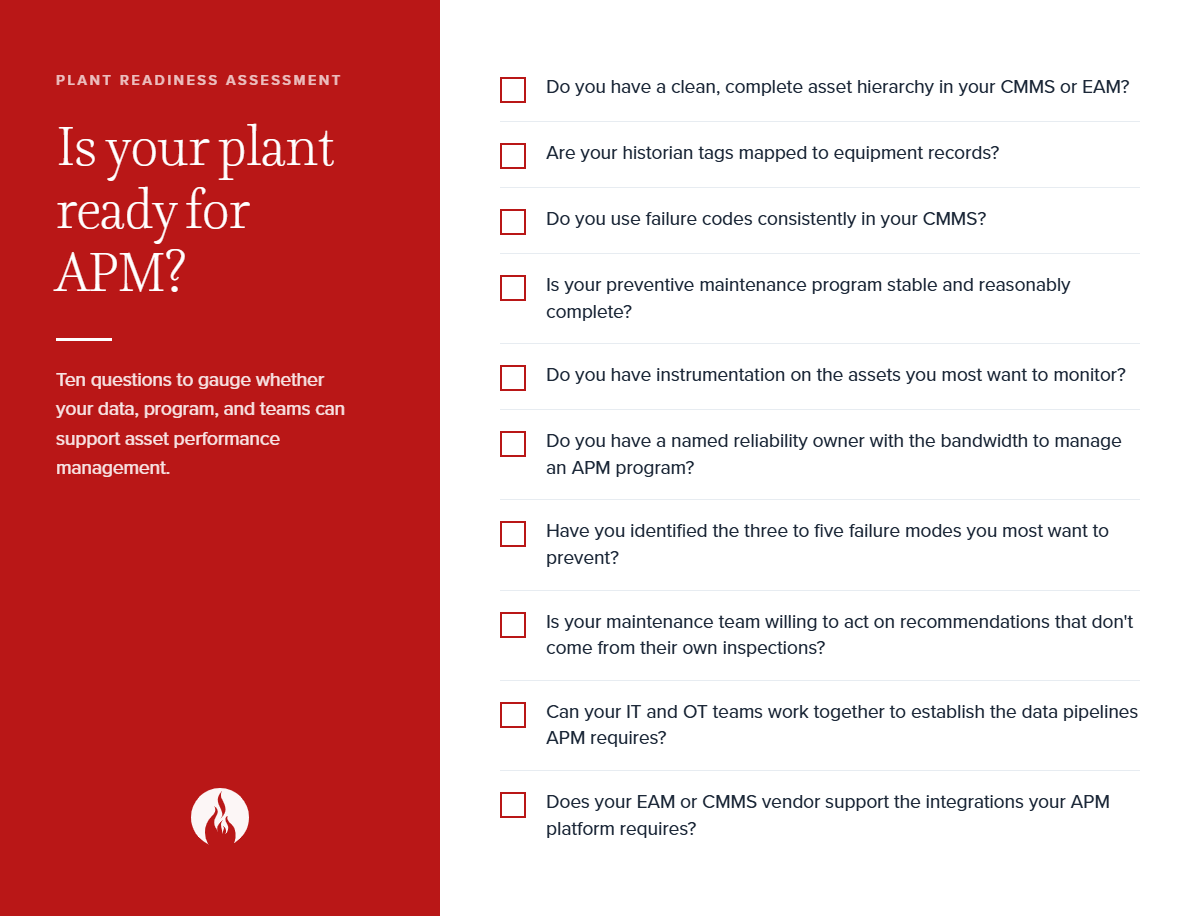
The adoption gaps described in this article are not hypothetical — they’re the specific barriers that reliability teams encounter when trying to move from APM pilot to APM program. Prometheus Group’s approach to APM is built around addressing these gaps structurally, not working around them.
The data fragmentation gap is addressed through MDaaS (Master Data as a Service), Prometheus Group’s managed master data solution. MDaaS helps organizations build and maintain the clean, consistent asset master data that APM requires — including equipment hierarchies, functional location structures, and the tag-to-asset mappings that connect historian data to CMMS records. For plants that are not yet ready for APM, MDaaS is often the right first investment: the data quality work pays off across every system that consumes asset data, not just APM.
Prometheus RapidAPM is not a standalone predictive layer — it is a module within the Prometheus-AI Platform, a unified EAM suite that includes planning and scheduling, shutdown and turnaround management, mobility, and more. This architecture means that RapidAPM shares a data foundation with the rest of the platform — asset records, work order history, and maintenance schedules are not replicated across two systems; they live in one. For organizations running SAP, IBM Maximo, or Oracle, RapidAPM integrates directly with those environments, with production-tested connectors rather than generic API-based integrations.
The workflow misfit gap is addressed by the integration between Prometheus RapidAPM and GWOS-AI Planning and Scheduling. When RapidAPM generates a predictive recommendation, that recommendation can flow directly into the planning and scheduling workflow — where it gets prioritized against other work, assigned to a crew, parts-checked, and scheduled in the maintenance window that operations has approved. The path from alert to work order is not a manual handoff; it’s a connected workflow.
For organizations evaluating APM readiness or rebuilding the reliability program foundations required for success, Prometheus Group’s EAM Consulting team works directly with site teams on the organizational and process side of APM adoption — including failure mode identification, business case development, and change management planning. This reflects the belief that APM is a reliability program, not a technology project, and that the consulting work is as important as the software.
Talk to a Prometheus Group reliability expert about where your program stands – and what it would take to close the gaps. Contact us.
The most common reason is workflow misfit — the system generates recommendations, but those recommendations don’t connect to how maintenance work actually gets planned and executed. When acting on an APM alert requires extra manual steps outside the normal maintenance workflow, teams initially do the extra work and gradually stop. A close second is data fragmentation: when the underlying asset and sensor data isn’t clean or well-connected, the system produces outputs that experienced maintenance teams don’t trust, and adoption collapses. Both problems are solvable, but they require investment in data and workflow foundations before or alongside the APM deployment.
A well-scoped APM pilot focused on three to five high-criticality assets with good instrumentation and clean data can produce demonstrable value in three to six months. The timeline extends significantly when data foundation work is required first, or when integration with legacy systems is more complex than originally estimated. Organizations should plan for a twelve-to-eighteen-month horizon for the first phase of a broader rollout, with the pilot serving as both a proof of value and a learning exercise for the full program.
In most cases, a functional preventive maintenance program should precede APM. APM is designed to augment a PM program — shifting some work from scheduled to condition-based — not to substitute for one. If the plant is still operating primarily reactively, the ROI from improving PM compliance and coverage will typically be higher than the ROI from APM, and the PM work creates the data foundation that APM needs. The exception is organizations where specific, high-cost failure modes are detectable with available sensor data — in those cases, a targeted APM deployment on those specific assets can run in parallel with broader reliability improvement work.
A predictive maintenance tool focuses on one part of the reliability workflow: detecting anomalies and predicting failures. A full APM platform connects that capability to the broader asset management lifecycle including work order management, planning and scheduling, shutdown coordination, maintenance history, and asset master data. The practical difference is whether a recommendation stops at the alert or closes the loop through to completed, documented maintenance work. In high-uptime environments, the gap between detection and resolution is where value is won or lost.
The core mechanics of APM — using sensor data and operational history to detect anomalies and predict failures — apply across industries, but the specific challenges and configuration requirements vary. Process industries (refining, chemicals, pulp and paper) tend to have rich instrumentation and historian data, but face challenges with OT/IT integration and high process variability that generates nuisance alarms. Discrete manufacturing plants often have weaker asset hierarchies and shorter equipment lifecycles. Utilities bring decades of reliability practice but highly regulated maintenance workflows. The most effective APM implementations are configured for the specific failure modes and data environment of the industry and plant type.
Prometheus RapidAPM is a native module within the Prometheus-AI Platform — a unified EAM suite that spans maintenance planning and scheduling, shutdown and turnaround management, reporting and analytics, mobility, permitting, contractor management, capital project management, environmental health and safety, and master data management. This is structurally different from standalone APM tools that require a third-party integration with an EAM system. Prometheus Group customers operate APM within the same platform where maintenance work is planned, tracked, and documented which directly addresses the workflow misfit problem that causes most APM programs to stall.
See the Prometheus Platform in Action
Discover how you can streamline your asset management processes and maximize your ROI.


.png?length=360&name=APM%20Maximo%20(1).png)