.svg)


Purpose-built intelligence for the operational core of oil and gas
The Intelligence Gap Isn’t in the Reservoir
The AI conversation in oil and gas fixates on the subsurface—seismic, reservoirs, exploration. Important work, but it overlooks where operators actually lose and recover time, money, and safety margin: the operational core of maintenance, turnarounds, permitting, asset data, and the day-to-day health of equipment. Offshore operators average around 27 days of unplanned downtime a year, on the order of $38 million. That is where AI can have the clearest, most immediate return.
How that AI is built matters. Prometheus Group draws a line between horizontal AI, which only suggests, and vertical AI, which interprets, decides, and executes inside the workflow itself. A general model can summarize a document; it cannot sequence a turnaround or read a pump’s health from its sensor history. Prometheus Group builds intelligence into those workflows directly, trained on decades of real maintenance data—purpose-built for asset-intensive operations, and proven in oil and gas.
In Their Own Words
Organizations see immediate improvements in their operations with Prometheus-AI:
“It’s clear this AI is being built the right way—with real customers in mind.”
— Enterprise Systems Manager, Multi-Billion-Dollar Refining Operation
“The ability to just type in what you’re wanting it to do is a huge plus for our users.”
— Analyst, High-Volume Corrugated Packaging Facility
“This AI doesn't just follow the process. It helps teach it.”
— Plant Maintenance IT Business Consultant, Leading Global Packaging Manufacturer
Where the Intelligence Lives
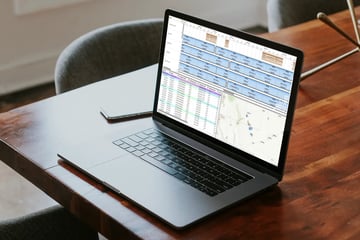
GWOS-AI — planning and scheduling. Trained on more than twenty years of maintenance data, GWOS-AI turns a noisy backlog into an executable schedule. Planners reassign resources in natural language and run AI-powered mass changes, while the system places preventive and corrective work and optimizes by crew or location. Step-by-step guidance enforces a standardized approach and cuts onboarding time for the new and rotating crews common to shift-based oil and gas operations.
DSO — upstream scheduling and optimization. In upstream operations, idle time is the most expensive kind: non-productive time can swallow more than 30% of a well's cost, and rig operating cost accounts for the bulk of the rest. DSO pulls well delivery—permitting, drilling, completion, facilities, and field operations—into a single optimized schedule, using an AI optimization engine built for upstream complexity to assign rigs, crews, and equipment to activities under real-world constraints. Planners build and compare multiple development-plan scenarios in minutes and run "What if?" analysis against cost, production, and KPIs, so a change or disruption can be absorbed without losing the plan—helping operators hit production targets and maximize return on assets.
STO-AI — turnarounds, shutdowns, and outages. The turnaround is the largest controllable event of a facility’s year and the one most exposed to overrun: industry benchmarks show more than two-thirds miss plan by at least 10% on cost or schedule, and a large refinery turnaround can exceed $100 million—usually because scope creeps in after the freeze date. STO-AI accelerates work-package creation from standardized templates, historical norms, and ERP data, while models trained on decades of operational history produce more accurate schedules, surface risks earlier, and optimise plans before execution. During the event, real-time dashboards and automated shift-change logs keep handovers clean and progress, delays, and resource readiness in full view.
ePAS-AI — permitting and safety. In the North Sea especially, the permit to work is the backbone of safety culture, with reason: at refineries, under 10% of time is spent in transient operations like startup and shutdown, yet more than half of process safety incidents occur then. ePAS-AI guides permit creation—prompting for job description, location, and scope, recommending values from similar historical permits, and pushing back on vague or incomplete entries. Its HIRA module auto-populates hazards and controls by work category, from welding and grinding to electrical, then compares against similar permits to surface missing hazards and quality gaps. Natural-language queries replace filter-building—how many hot-work permits are active, average cycle time by type, what is awaiting approval—with instant answers. And by tracking isolations and lockouts across permits, it flags conflicts between jobs sharing equipment and mismatched isolation conditions before work begins.
MDaaS-AI — the data foundation. None of it works on bad data. Gartner puts the cost of poor data quality at an average of $12.9 million a year, with companies losing an estimated 15–25% of revenue to it. MDaaS-AI uses AI to standardize, cleanse, and enrich material masters—assigning noun and modifier, parsing manufacturer and part numbers, and analyzing and building out bills of materials against ERP structures. For operators carrying vast MRO inventories across complex rotating equipment, that means accurate spares, lower supply-chain cost, and a master record the platform can trust.
RapidAPM — asset performance. Further along the curve, RapidAPM monitors every sensor on every asset, using AI and neural networks to detect reliability and efficiency issues before they become failures that can cost up to $149 million per site. Crucially, it prioritizes alerts, cutting through the flood of notifications operators field every day, so teams act on the signals that matter rather than drowning in noise. McKinsey research suggests predictive maintenance can reduce downtime by 30–50% and extend equipment life by 20–40%, while built-in Value-at-Risk and ROI calculators put a number on each avoided failure.
On the connected Prometheus-AI Platform, intelligence compounds: clean data sharpens scheduling, one asset record feeds permits and work orders, and Prometheus Group is adding new AI across the platform at pace.
The Operational Dividend
The pressures defining oil and gas—aging assets, tighter margins, demanding safety, an energy transition asking more of the assets already in the ground—are operational at root. That is where purpose-built intelligence earns its place: not the AI that looks deepest into the earth, but the kind that works alongside the people keeping the operation running.